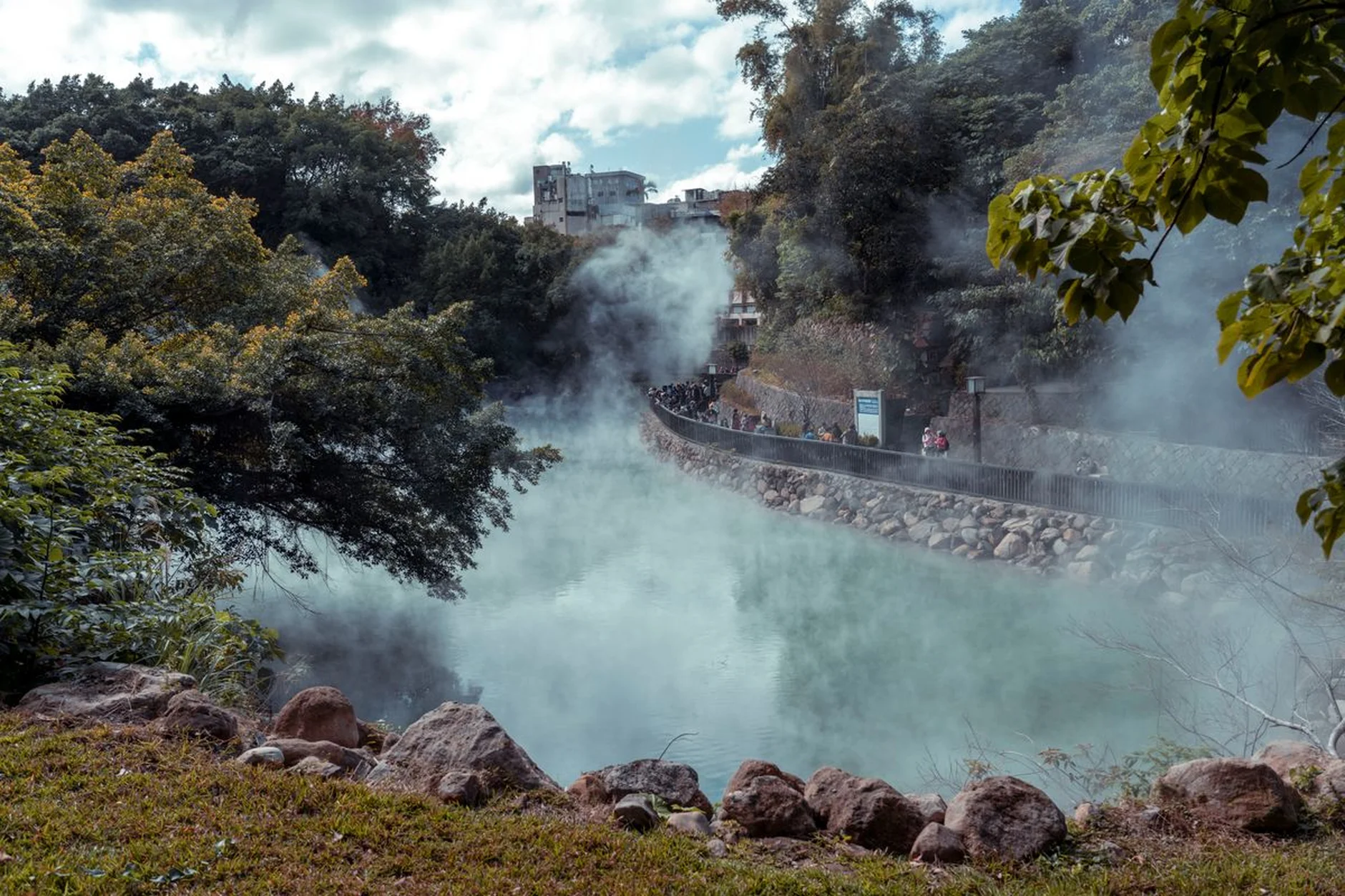
Beitou Hot Springs

🇹🇼 Taiwan · Taipei

Beitou Hot Springs

Manantiales / Beitou Hot SpringsSprings / Beitou Hot Springs温泉・鉱泉 / Beitou Hot Springs

♨ Temperatura

55°C

⛰ Altitud

28 m

⚗ pH

1.5

💧 TDS

980 mg/L

🌊 Caudal

12 L/s

📅 Establecido

1896

♨ Temperature

55°C

⛰ Altitude

28 m

⚗ pH

1.5

💧 TDS

980 mg/L

🌊 Flow rate

12 L/s

📅 Established

1896

♨ 温度

55°C

⛰ 標高

28 m

⚗ pH

1.5

💧 TDS

980 mg/L

🌊 流量

12 L/s

📅 開設

1896

RadiumSulphurousSodium Bicarbonate

✓ Verificado el 2026-07-22

✓ Verified on 2026-07-22

✓ 確認日 2026-07-22

Beitou es un distrito de aguas termales volcánicas al pie del monte Datun, integrado en el borde norte de Taipei. Sus manantiales producen tres tipos distintos de agua: la acidísima 'fuente verde de azufre' (pH 1,2–1,5, la más rara), las aguas bicarbonatadas sódicas y las aguas radiactivas que depositan hokutolita, un mineral hallado únicamente en Beitou y en un único punto de la prefectura de Akita (Japón). Los administradores coloniales japoneses desarrollaron el distrito desde 1896 construyendo casas de baños públicas al estilo onsen; la casa de baños pública de Beitou de 1913 es hoy un monumento histórico protegido y museo de aguas termales. La estación de MRT de Xinbeitou está en la entrada del distrito, lo que convierte a Beitou en el destino de aguas termales más accesible en transporte público de cualquier gran ciudad asiática.

Beitou is a volcanic hot spring district at the foot of Datun Mountain, integrated into the northern edge of Taipei. Its springs produce three distinct water types: the milky-green acidic 'green sulphur spring' (pH 1.2–1.5, the rarest type), the sodium bicarbonate 'white spring', and the radium-bearing waters that deposit hokutolite — a mineral found only in Beitou and a single location in Japan's Akita Prefecture. Japanese colonial administrators developed the district from 1896, building public bathhouses modelled on Japanese onsen culture; the 1913 Beitou Public Bathhouse is now a preserved historical monument and hot spring museum. The Xinbeitou MRT station sits at the district entrance, making Beitou the most transit-accessible hot spring destination of any major Asian city.

Beitou Hot Springsは台湾・Taipeiに位置する硫黄泉・炭酸水素ナトリウム泉。源泉温度は55.0℃の豊かな温泉水が湧き出る。泉水は強酸性(pH約1.5)の泉質、炭酸水素塩泉・ナトリウム泉を豊富に含む、総溶解固形物980 mg/Lが特徴だ。1896年創業。皮膚科治療・循環器系・リラクゼーションなど多様な温浴療法が行われる。施設では入浴・足湯・水治療法などが体験できる。

Minerales

Minerals

ミネラル

Sulphur (H₂S)38.5 mg/L
Radium (trace)0.002 mg/L
Sodium142 mg/L
Chloride98 mg/L
Bicarbonate210 mg/L

Tratamientos

Treatments

トリートメント

DermatologyCirculatoryRelaxationSkin Rejuvenation

Técnicas

Techniques

技法

BathingFoot BathHydrotherapy

Patrimonio

El Baño Público de Beitou (1913) es uno de los ejemplos más antiguos que se conservan de la arquitectura pública colonial japonesa en Taiwán y hoy está declarado monumento histórico. El descubrimiento de la hokutolita —un mineral único que contiene radio— en los manantiales de Beitou en 1905 situó al distrito en la literatura científica internacional.

Heritage

The Beitou Public Bathhouse (1913) is one of the oldest surviving examples of Japanese colonial public architecture in Taiwan and is now a designated historical monument. The discovery of hokutolite — a unique radium-bearing mineral — in Beitou's springs in 1905 placed the district in international scientific literature.

文化財

北投公共浴場(1913年)は、台湾に現存する日本統治時代の公共建築の中でも最古の例のひとつであり、現在は史跡に指定されている。1905年に北投の温泉で発見された北投石——ラジウムを含む独特の鉱物——は、この地区を国際的な科学文献の中に位置づけることとなった。

Cultura

La identidad de Beitou es inseparable de la tradición japonesa del onsen, trasplantada durante el periodo colonial (1895-1945). El distrito combina la arquitectura japonesa de casas de baños con la cultura callejera de la comida taiwanesa, creando un barrio en el que las casas de baños de piedra del siglo XIX conviven con hoteles boutique modernos y canales públicos al aire libre de baños de pies abiertos a los transeúntes.

Culture

Beitou's identity is inseparable from the Japanese onsen tradition transplanted during the colonial period (1895–1945). The district blends Japanese bathhouse architecture with Taiwanese street food culture, creating a neighbourhood where 19th-century stone bathhouses sit beside modern boutique hotels and outdoor public foot-bath channels open to passersby.

文化

北投のアイデンティティは、植民地時代(1895年-1945年)に移植された日本の温泉文化と切り離せない。この地区は日本式の浴場建築と台湾の屋台文化を融合させており、19世紀の石造りの浴場が現代的なブティックホテルや、通行人に開放された屋外の公共足湯水路と隣り合う独特の街並みを生み出している。

Sostenibilidad

Los manantiales de Beitou fluyen a partir de la actividad fumarólica volcánica del monte Datun, que forma parte del Parque Nacional de Yangmingshan, un paisaje volcánico protegido. La asignación del agua termal está regulada por el Gobierno de la Ciudad de Taipéi para evitar la sobreextracción. La conexión mediante el MRT público hace de Beitou uno de los destinos termales de menor huella de carbono de Asia.

Sustainability

Beitou's springs flow from volcanic fumarolic activity on Datun Mountain, which is part of the Yangmingshan National Park — a protected volcanic landscape. Spring water allocation is regulated by the Taipei City Government to prevent overextraction. The public MRT connection means Beitou is one of the lowest-carbon thermal destinations in Asia.

持続可能性

北投の温泉は、陽明山国立公園——保護された火山景観——の一部である大屯山の火山性噴気活動から湧出している。温泉水の配分は台北市政府によって規制されており、過剰採取を防止している。公共のMRT(地下鉄)で結ばれていることから、北投はアジアで最も低炭素な温泉地のひとつとなっている。

Contacto

Sitio webwww.taipeitravel.net/en/hot-spring.html

DirecciónXinbeitou District, Taipei City, Taiwan 112

Contact

Websitewww.taipeitravel.net/en/hot-spring.html

AddressXinbeitou District, Taipei City, Taiwan 112

連絡先

ウェブサイトwww.taipeitravel.net/en/hot-spring.html

住所Xinbeitou District, Taipei City, Taiwan 112

← Volver al directorio completo Ver en el mapa interactivo← Back to the full directory View on the interactive map← ディレクトリ全体に戻る インタラクティブマップで見る