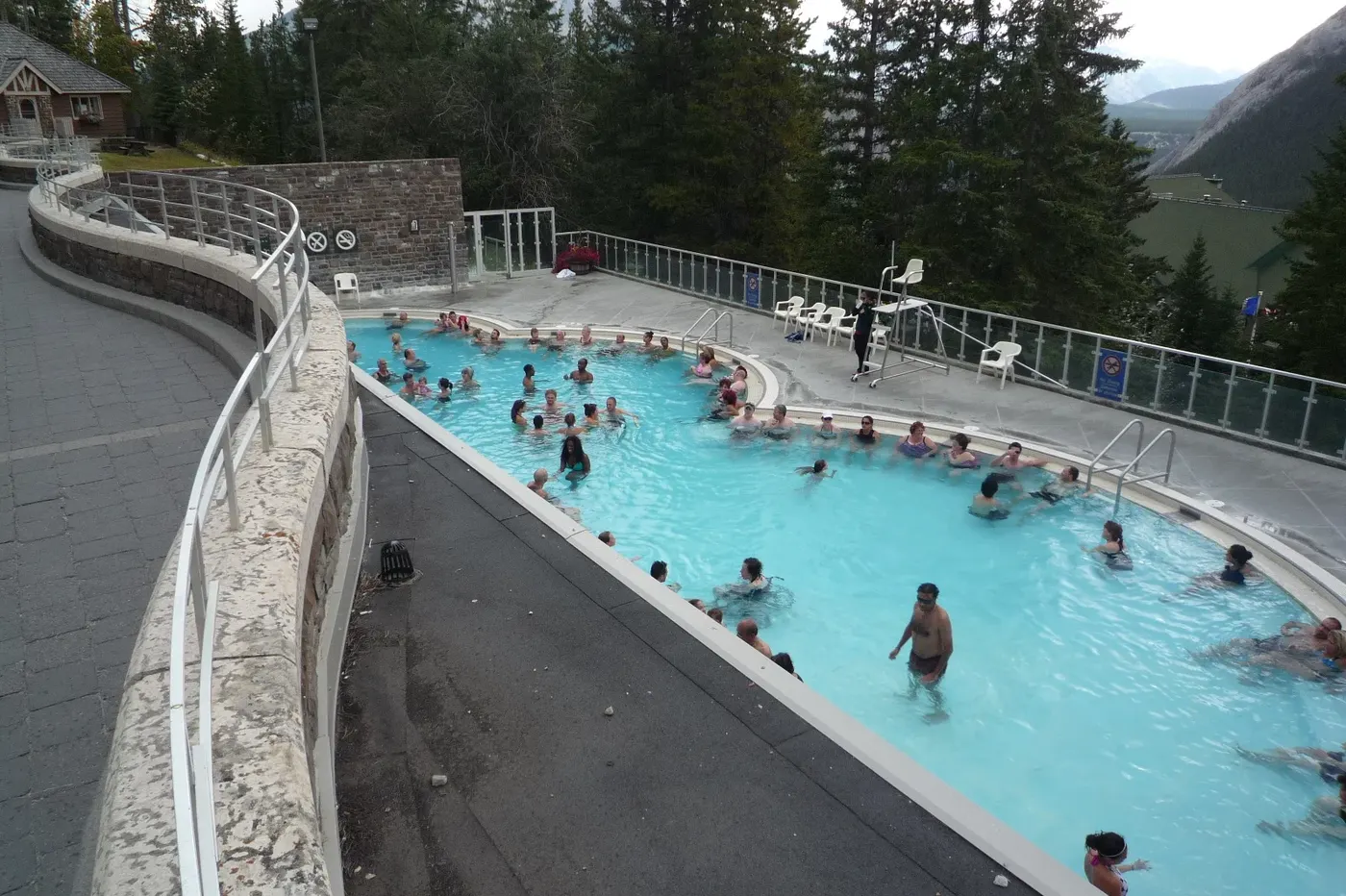
Photo by Vigorous action, via Wikimedia Commons (CC BY-SA 3.0)
🇨🇦 Canada · Alberta, Rocky Mountains
Photo by Vigorous action, via Wikimedia Commons (CC BY-SA 3.0)
🇨🇦 Canada · Alberta, Rocky Mountains
♨ Temperature
40°C
⛰ Altitude
1585 m
⚗ pH
7.6
💧 TDS
2400 mg/L
🌊 Flow rate
6 L/s
📅 Established
1883
✓ Verified on 2026-07-22
The discovery of the Banff Hot Springs in 1883 by Canadian Pacific Railway workers directly led to the creation of Canada's first national park. The sulphate-calcium waters emerge from Sulphur Mountain's limestone bedrock and are rich in magnesium, potassium, and bicarbonate. Bathing year-round against a backdrop of the Rocky Mountains at −20°C outside is a quintessential Canadian experience.
| Sulphate | 1100 mg/L |
| Calcium | 520 mg/L |
| Magnesium | 95 mg/L |
| Bicarbonate | 380 mg/L |
| Potassium | 14 mg/L |
The discovery of Banff's springs by CPR workers in 1883 directly led to the creation of Canada's first national park in 1885. The springs are a National Historic Site and their management has been central to the evolution of Canadian conservation philosophy for 140 years. Indigenous peoples of the Treaty 7 area — the Stoney Nakoda, Blackfoot, and Kootenai — used the springs long before European discovery.
Banff Hot Springs sparked Canada's national parks movement — the idea that natural places of beauty and wonder should be held in public trust for all Canadians. The springs attracted wealthy tourists via the Canadian Pacific Railway, establishing a tradition of democratised access to wilderness that became a cornerstone of Canadian national identity.
Banff National Park operates under some of the strictest conservation regulations of any park in the world — no resource extraction, no development outside designated areas, and extensive wildlife corridor preservation. The hot springs' aquifer is monitored by Parks Canada to track flow rates and water quality. The park's ecological integrity is the primary management objective, with tourism considered a secondary benefit.
Phone+1 403 762 1515
Websitewww.pc.gc.ca/banff-hotsprings
AddressMountain Ave, Banff, AB T1L 1B3, Canada