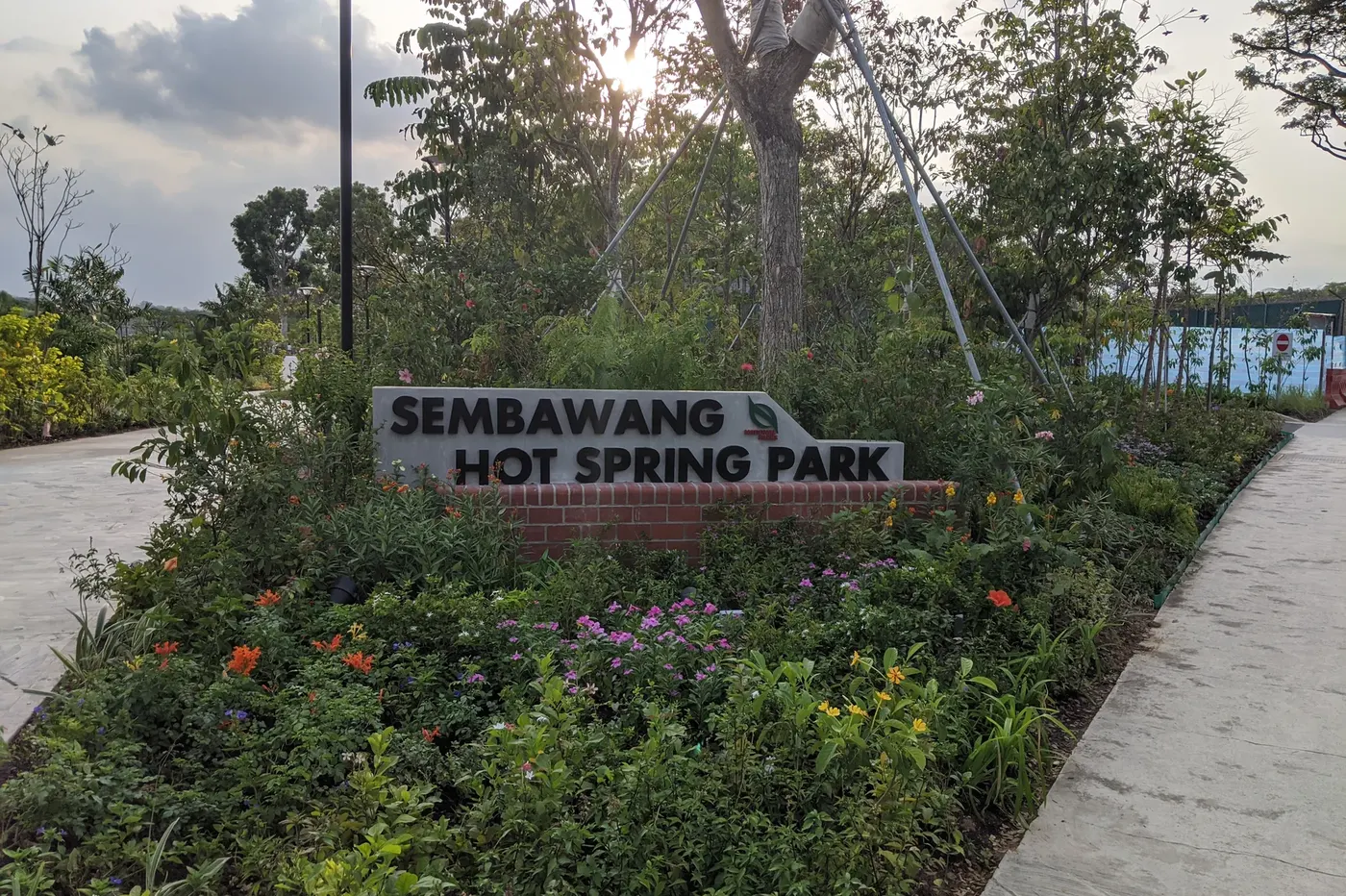
Photo by TheGreatSG'rean, via Wikimedia Commons (CC BY-SA 4.0)
🇸🇬 Singapore · Sembawang, North Singapore
Photo by TheGreatSG'rean, via Wikimedia Commons (CC BY-SA 4.0)
🇸🇬 Singapore · Sembawang, North Singapore
♨ Temperature
70°C
⛰ Altitude
12 m
⚗ pH
7.2
💧 TDS
320 mg/L
🌊 Flow rate
1.2 L/s
📅 Established
Discovered 1909 during British colonial rubber plantation clearing; public park reopened 2020
✓ Verified on 2026-07-22
Sembawang Hot Spring Park is one of Southeast Asia's most unusual urban nature destinations: a free public hot spring facility in the residential northern district of Sembawang, on an island-state that has no volcanic activity, no tectonic boundary proximity, and no obvious geological reason to produce hot springs at all. The springs emerge at approximately 70°C from a granite basement aquifer — remarkably high for a non-volcanic setting — through a fault or fracture zone in the ancient Bukit Timah Granite that underlies much of northern Singapore. The water is then cooled to approximately 42°C in public foot-bath basins, and portable kettles are available for visitors to draw hot spring water. The springs were discovered in 1909 when British colonial engineers clearing land for a rubber plantation encountered the anomalous warm water seeping through the cleared ground. The site was subsequently a source of hot water for the local Sembawang naval base and surrounding communities during the British colonial period. It was developed as a public spa facility and then fell into disuse; the National Parks Board of Singapore (NParks) reopened it as Sembawang Hot Spring Park in December 2020 following extensive landscape restoration. The park is remarkable for combining the geological improbability of a hot spring in equatorial lowland Singapore with the cultural improbability of a barefoot, communal outdoor soaking tradition in one of the world's most climate-controlled, air-conditioned urban environments.
| Silica | 48 mg/L |
| Sodium | 62 mg/L |
| Calcium | 18 mg/L |
| Chloride | 35 mg/L |
| Fluoride | 0.8 mg/L |
Sembawang was historically a Malay fishing village (kampung) before British colonial development transformed it into a naval and industrial district. The Royal Navy's HMS Terror and HMS Sembawang bases dominated the northern shore for most of the 20th century. The hot spring sits in a zone of transition between old Malay kampung memory, British naval history, and the Housing Development Board townships that replaced both. The geological anomaly of the spring — warm granite-heated water in a geologically stable equatorial lowland — is itself a form of heritage: a reminder that Singapore's flat, reclaimed, air-conditioned present sits atop a much older geological story.
The Sembawang Hot Spring is a specifically Singaporean kind of public space: free, accessible by MRT, carefully landscaped by a government agency, and equipped with instructional signs in four languages. And yet what happens within it — bare feet on warm stone, shared basins of steaming water, elderly Singaporean Chinese, Malay, and Indian visitors sitting together at the foot baths — is as ancient and universal as the act of bathing in warm water has ever been. The park became popular during the post-pandemic period as Singaporeans sought outdoor recreation close to home, and it now attracts both local regulars and curious international visitors for whom a hot spring in Singapore represents a genuine surprise.
The Bukit Timah Granite aquifer feeding Sembawang's spring is an ancient crystalline basement formation. The spring flows naturally at a rate of approximately 1.2 L/s without pumping, and NParks monitors output and temperature as part of ongoing park management. The park's landscape design channels excess spring water into a wetland feature that supports native aquatic plants and provides habitat continuity within Singapore's park connector network.
Websitenparks.gov.sg/gardens-parks-and-nature/parks-and-nature-reserves/sembawang-hot-spring-park
AddressGambas Avenue, Sembawang, Singapore 757091