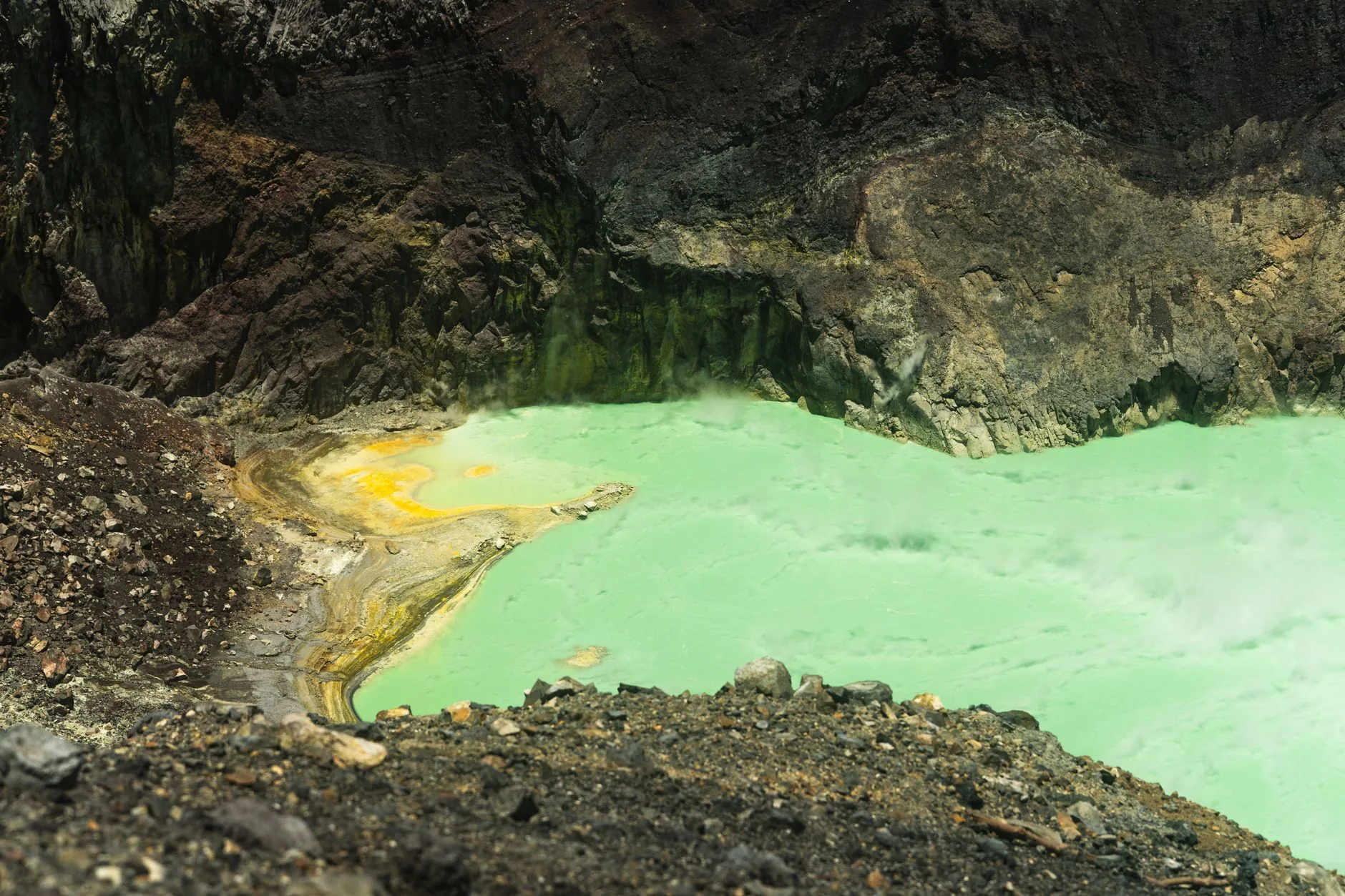
Photo by XeresNelro, via Wikimedia Commons (CC BY-SA 4.0)
🇩🇲 Dominica · Morne Trois Pitons National Park, Eastern Caribbean
Photo by XeresNelro, via Wikimedia Commons (CC BY-SA 4.0)
🇩🇲 Dominica · Morne Trois Pitons National Park, Eastern Caribbean
♨ Temperature
92°C
⛰ Altitude
760 m
⚗ pH
2.5
💧 TDS
6400 mg/L
🌊 Flow rate
N/A (volcanic vent lake)
📅 Established
Reported by European observers in 1870s; national park established 1975
✓ Verified on 2026-07-22
Dominica is the most volcanically active island in the Eastern Caribbean, and the Boiling Lake is its most extraordinary geological feature. The lake is a flooded fumarole — a volcanic vent filled with boiling, bubbling water, typically grey-blue and perpetually veiled in a cloud of steam, sitting at approximately 92°C at its centre. Access requires a full-day guided trek of around 13 kilometres through the Valley of Desolation, a sulphurous highland landscape of fumaroles, boiling mud pools, hot springs, and volcanic vents. The valley earns its name from the eerie silence of a landscape largely devoid of vegetation, broken only by the hiss of steam and the gurgle of acidic water. Dominica is sometimes called 'the Nature Island of the Caribbean' for the density of its rainforest, volcanic terrain, and freshwater systems. The island has 365 rivers — one for every day of the year, it is said. The entire geothermal zone is part of Morne Trois Pitons National Park, a UNESCO World Heritage Site inscribed in 1997.
| Sulphate | 2800 mg/L |
| Chloride | 980 mg/L |
| Silica | 640 mg/L |
| Sodium | 880 mg/L |
| Carbon Dioxide | 1400 mg/L |
| Iron | 18 mg/L |
Dominica was the last Caribbean island to be colonized by Europeans, owing largely to the fierce resistance of the Kalinago (Carib) people, who retained control of much of the island well into the 18th century. The Kalinago Territory — a 3,700-acre reserve established in 1903 — on the island's northeastern coast is the only remaining territory in the Eastern Caribbean governed by Kalinago communities. The volcanic landscape, including the geothermal zone, holds significance in Kalinago oral tradition.
Dominica's Boiling Lake was first reported in Western scientific literature by H.A. Nicholls and Edmund Watt in 1875. The lake has periodically drained, deflated, and refilled — most dramatically in 2004 — as deep volcanic pressures shift beneath the Morne Trois Pitons volcanic complex. The island's low tourism infrastructure, relative to its neighbours, has preserved both its ecosystem and its cultural distinctiveness.
Morne Trois Pitons National Park covers 6,857 hectares and is Dominica's core protected area. The UNESCO inscription specifically recognizes the park's outstanding volcanic and biodiversity values. Dominica has pursued a long-term strategy of positioning itself as an eco-tourism destination rather than mass-market tourism, including a commitment to become the world's first climate-resilient nation after Hurricane Maria caused catastrophic damage in 2017.
Phone+1 767-448-2033
Websitewww.dominica.dm
AddressMorne Trois Pitons National Park, Laudat, Dominica