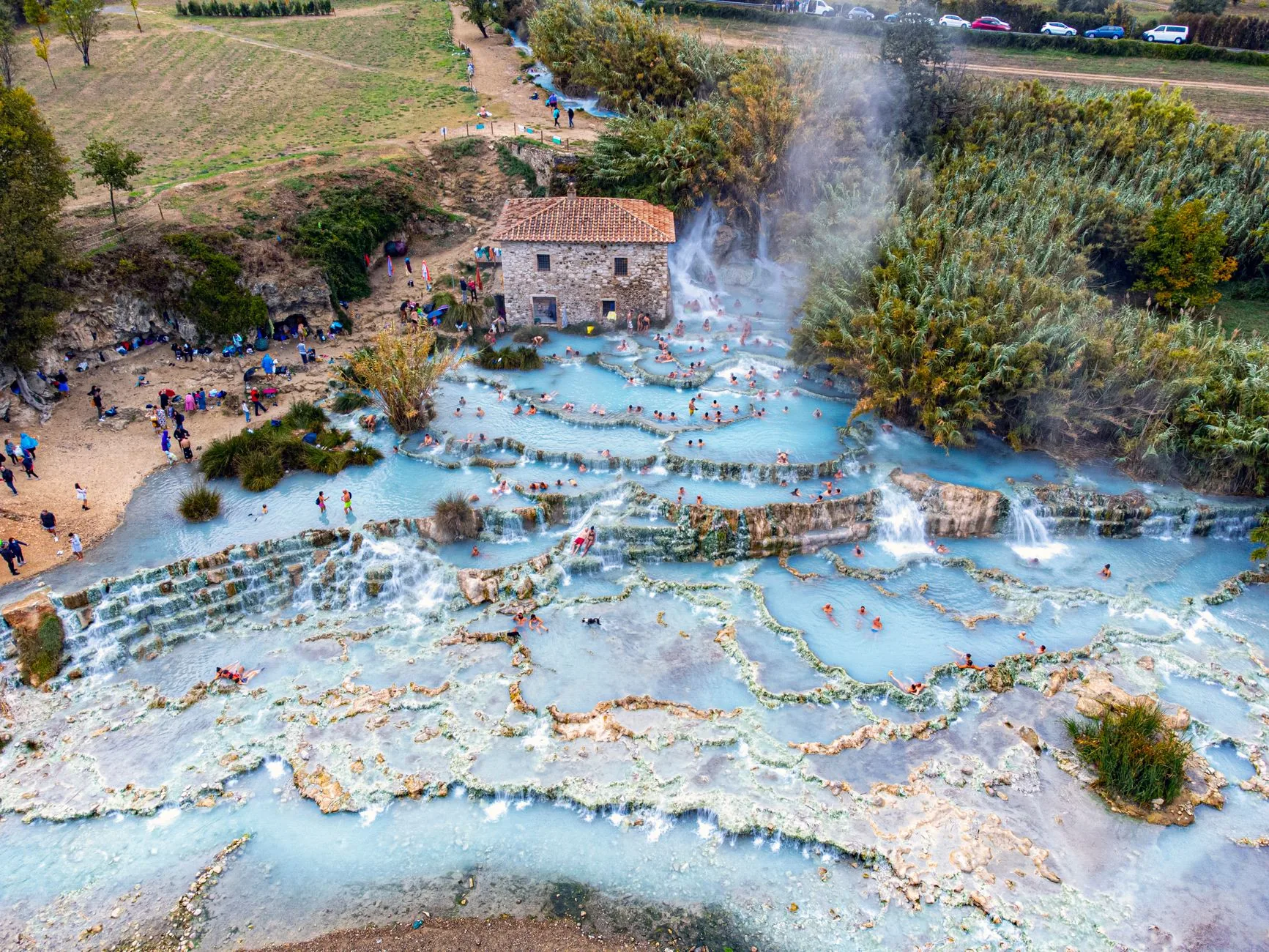
Photo by Mattze77, via Wikimedia Commons (CC BY-SA 4.0)
🇮🇹 Italy · Tuscany
♨ Temperature
37.5°C
⛰ Altitude
165 m
⚗ pH
6.3
💧 TDS
2900 mg/L
🌊 Flow rate
500 L/s
📅 Established
Etruscan period
✓ Verified on 2026-09-11
Terme di Saturnia are among Europe's most spectacular thermal springs, erupting from a volcanic crater in the Maremma hills of Tuscany. The water emerges at a constant 37.5°C and is rich in hydrogen sulphide, carbon dioxide, and bicarbonate minerals. The cascade pools — known as Cascate del Mulino — are free to the public and have attracted visitors for over 3,000 years. Ancient Etruscans, Romans, and medieval pilgrims all bathed here. The mineral-rich water is recognized by Italian health authorities for its therapeutic effects on skin, joints, and the respiratory system.
The Saturnia hot springs emerge from a volcanic aquifer beneath Tuscany's Maremma region at a constant 37.5°C, carrying sulphur, bicarbonate, and dissolved carbon dioxide that give the water its faint sulphurous smell and its milky-turquoise color. The water has deposited travertine — the same soft limestone quarried for buildings across Tuscany — into the natural cascading pools that make the site so distinctive. Etruscan and later Roman settlers used the springs continuously from at least the 3rd century BC, and local legend attributes their creation to a thunderbolt hurled by Saturn, the god who gave the village its name. Roman-era bath remains are still visible near the site today.
There are two distinct ways to experience Terme di Saturnia, and it's easy to book the wrong one by mistake. The Cascate del Mulino are free, open-access travertine cascades beside an old mill, open 24 hours a day with no ticket and no facilities beyond a paid parking area — expect a rustic, crowded, very photogenic scene, especially around sunset. About a kilometer away, the private Terme di Saturnia Spa & Golf Resort offers a landscaped, ticketed pool complex fed by the same spring, with changing rooms, restaurants, loungers, and a full spa menu — a calmer, more curated version of the same water.
The Cascate del Mulino waterfalls cost nothing to enter — parking is the only fee, typically a few euros for the day. Terme di Saturnia tickets for the resort side are separate and priced by day pass, generally in the range of €25–45 per person depending on season and day of the week, with reduced rates sometimes available on weekdays. Spa treatments, private cabanas, and hotel stays at the resort are booked and priced separately from the day pass. Because the free cascades and the paid resort are two different businesses, always check which one a ticket or booking actually refers to before paying.
Terme di Saturnia sits in a rural part of southern Tuscany with no train station nearby; the closest rail connections are in Grosseto or Albinia, roughly 45–60 minutes away by car or infrequent local bus. Most visitors drive, either as a day trip from Rome or Florence (both around two hours away) or as part of a wider Maremma road trip. The free Cascate del Mulino have their own signposted parking area off the SP10 road, separate from the resort's own car park, so GPS directions should specify which one you're heading to.
Spring and autumn offer the best balance of mild weather and manageable crowds at the free Cascate del Mulino, which get extremely busy on summer weekends and around sunset year-round. Arriving early on a weekday morning is the most reliable way to see the cascades without a crowd. Winter visits are quieter still and dramatic, with steam rising off the 37.5°C water against cold air. The resort side, being ticketed and capacity-controlled, is more consistent throughout the year and is a reasonable alternative when the free cascades are at their most crowded.
| Sulphur (H₂S) | 2.8 mg/L |
| Bicarbonate | 1874 mg/L |
| Calcium | 562 mg/L |
| Magnesium | 79 mg/L |
| Sodium | 118 mg/L |
| Carbon Dioxide | 940 mg/L |
Protected under Italian national heritage statutes, Saturnia's springs have been in continuous use since the Etruscan era, over 3,000 years ago. The site includes remains of Roman-era bath infrastructure and is part of the broader Maremma archaeological landscape. The Cascate del Mulino — its iconic travertine waterfall — is a geologically protected formation.
In Etruscan mythology, the springs were said to be created by a thunderbolt of Saturn, god of time and agriculture — giving the town its name. The waters have been central to local Tuscan identity for over three millennia, shaping agriculture, settlement patterns, and communal rituals around bathing as a social and spiritual act.
The Saturnia spring flows at 500 L/s with no external pumping — entirely gravity-fed from volcanic bedrock, making it one of the most energy-efficient natural thermal systems in the world. The free public cascade pools consume zero energy. Visitor management limits erosion of the travertine formations, and the surrounding Maremma region is a protected wetland biosphere.