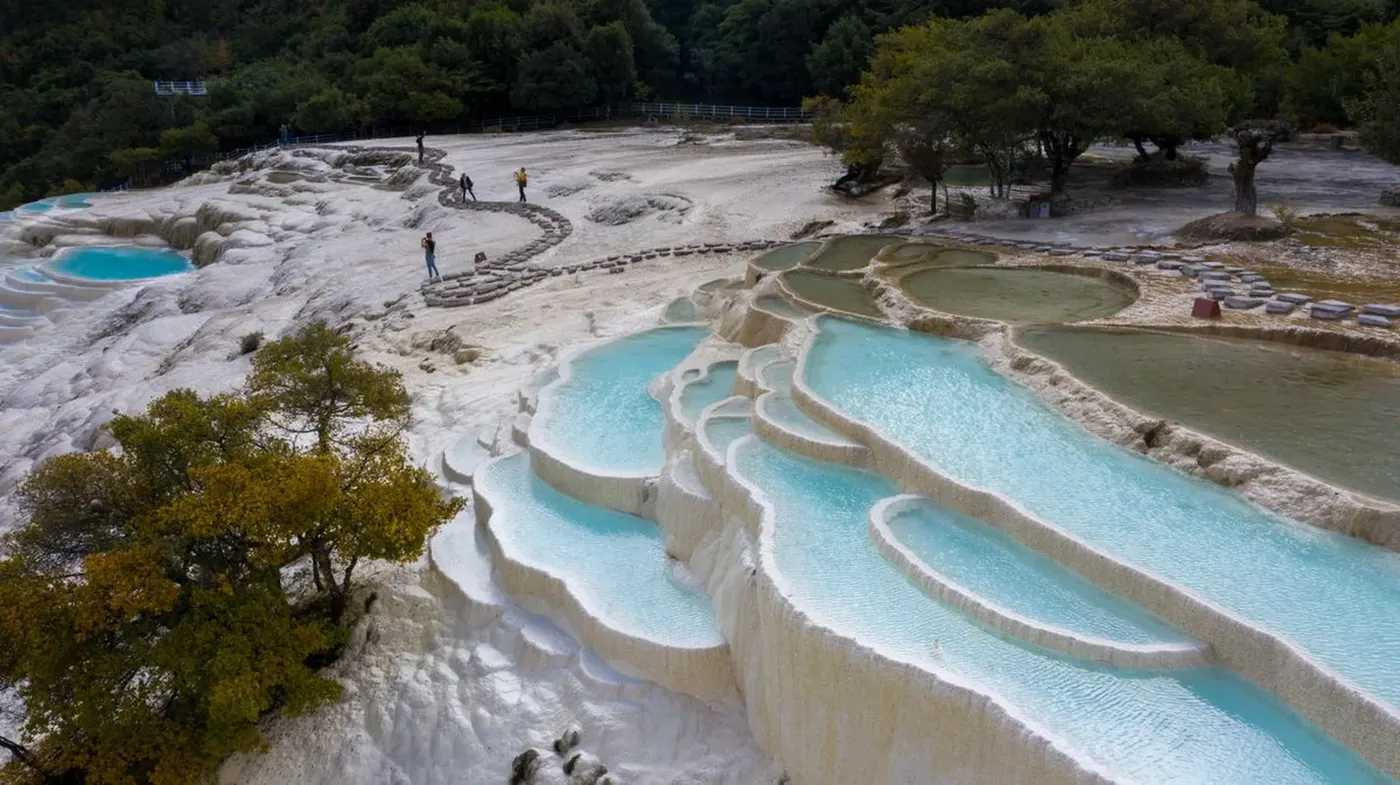
Photo by Greece China News on Pexels
🇨🇳 China · Beijing
♨ Temperature
50°C
⛰ Altitude
46 m
⚗ pH
7.6
💧 TDS
1240 mg/L
🌊 Flow rate
65 L/s
📅 Established
Liao Dynasty (10th century)
✓ Verified on 2026-07-22
Xiaotangshan Hot Springs, 40 km north of Beijing, has been the therapeutic retreat of Chinese emperors for over a millennium. The springs were first developed by the Liao Dynasty in the 10th century AD, expanded by the Jin and Yuan emperors, and reached their greatest glory under the Qing Emperor Kangxi, who built an imperial villa here in the late 17th century that became his favourite summer retreat. The spring water, a mild sulphurous and bicarbonated thermal at 50°C, was prescribed by imperial physicians for skin disorders, joint pain, and fatigue recovery. Today the resort is accessible from Tianjin's cruise port via 35-minute high-speed rail to Beijing, followed by a 40-minute drive to the springs, placing an imperial wellness destination within reach of cruise visitors exploring China's capital.
| Sulphate | 580 mg/L |
| Bicarbonate | 310 mg/L |
| Calcium | 125 mg/L |
| Sodium | 165 mg/L |
| Silica | 38 mg/L |
The imperial history of Xiaotangshan spans 1,000 years and four dynasties. The Qing Emperor Kangxi's personal physician recorded the spring's mineral composition in 1694 — one of the earliest systematic analyses of a Chinese thermal spring. The imperial pavilion complex built by Kangxi was partially destroyed during the Second Opium War in 1860 and rebuilt in 1906; the remaining structures are protected as Beijing municipal heritage sites.
Xiaotangshan embodies the Chinese imperial concept of 'yang sheng' (cultivating life) — the idea that thermal bathing, combined with proper diet and meditation, extends lifespan and preserves youthful vigour. This concept, rooted in Daoist philosophy, made imperial spring resorts central to dynastic court culture. Emperor Kangxi's famous longevity (he reigned for 61 years) was popularly attributed in part to his regular spring retreats at Xiaotangshan.
Beijing municipal authorities designated Xiaotangshan a protected groundwater zone in 1998, prohibiting any extraction above licensed quotas. The spring's water table is monitored by the Beijing Geological Research Institute, which has documented declining aquifer levels due to urban expansion, prompting a government programme to restrict development and promote aquifer recharge. Modern resort facilities use closed-loop thermal systems to reduce water consumption.
Phone+86 10-6978-8888
Websitewww.xiaotangshan.com
AddressXiaotangshan Town, Changping District, Beijing, China