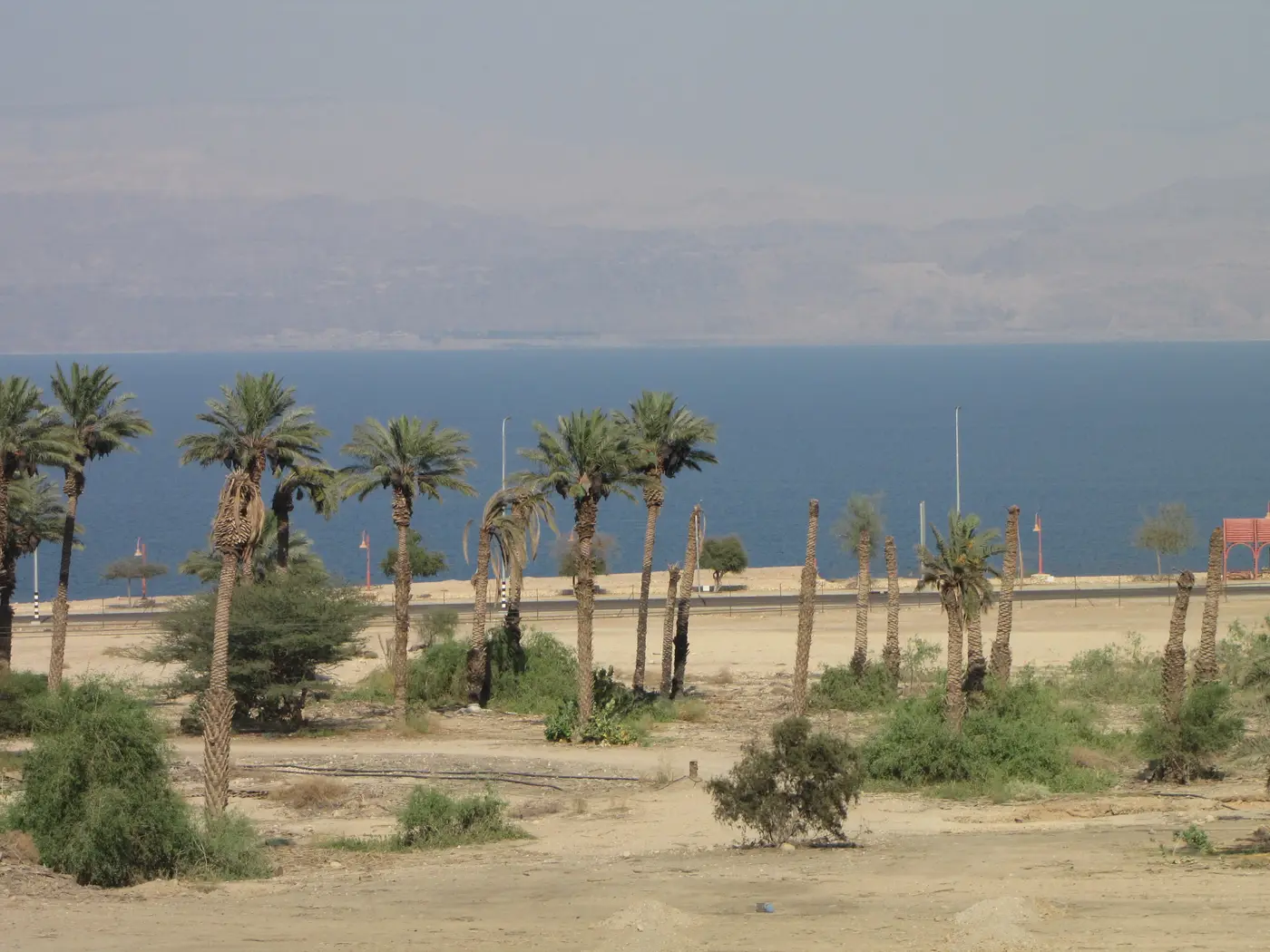
Photo by Ziko van Dijk via Wikimedia Commons, CC BY-SA 3.0
🇯🇴 Jordan · Balqa Governorate
Photo by Ziko van Dijk via Wikimedia Commons, CC BY-SA 3.0
🇯🇴 Jordan · Balqa Governorate
♨ Temperature
—
⛰ Altitude
-430 m
⚗ pH
—
💧 TDS
—
🌊 Flow rate
—
📅 Established
Documented since antiquity; modern resort development along the Jordanian shore began in the late 20th century
✓ Verified on 2026-08-16
The Dead Sea sits at the lowest point on the surface of the Earth — roughly 430 metres below sea level and dropping further each year — filling a deep basin of the Jordan Rift Valley on the border between Jordan and Israel/Palestine. Its water is roughly 34% salt, nine to ten times saltier than the open ocean, dominated by magnesium chloride, potassium chloride, and sodium chloride, with the highest bromide concentration found in any water on Earth. That extreme density makes floating on the surface almost unavoidable, the sea's most famous characteristic. Along the Jordanian shore, the resort area of Sweimeh combines direct brine bathing with application of the sea's dark mineral-rich mud, a combination that has made the Dead Sea one of the world's most established destinations for dermatological and rheumatic wellness tourism, particularly for psoriasis treatment. The surrounding landscape is stark desert framed by the mountains of the Jordan Rift Valley, with the hills of the West Bank visible across the water.
The Dead Sea has drawn visitors for its remarkable waters since antiquity: ancient Egyptians used its exported bitumen in mummification, Nabataean traders profited from its resources, and Roman-era writers and physicians documented its therapeutic reputation among the ailments of the Decapolis region. The Jordanian shore sits within the biblical landscape referenced throughout Hebrew scripture, near the traditional sites associated with Sodom and Gomorrah at the sea's southern end. King Herod the Great is recorded by Josephus as having sought relief in the warm springs of the eastern Dead Sea shore near Callirrhoe during his final illness — part of the same ancient tradition of seeking healing at the lowest point on Earth's land surface.
The Dead Sea is one of the most recognizable natural landmarks in the world, famous above all for the effortless buoyancy its extreme salinity (roughly 34%, about 9-10 times saltier than the ocean) gives bathers — floating on your back reading a newspaper is the sea's signature photograph. Jordanians and international visitors alike travel to the Sweimeh resort strip on the eastern shore for the combination of mineral-rich brine bathing and the dark, silky mud from the seabed, which is scooped up and applied directly to the skin. The mineral composition — dominated by magnesium chloride, potassium chloride, and sodium chloride, with the highest bromide concentration of any water on Earth — has made the Dead Sea one of the world's most established destinations for dermatological wellness tourism, particularly for psoriasis and other skin conditions.
The Dead Sea faces a well-documented environmental crisis: its water level has dropped by more than a metre per year for decades, driven by upstream diversion of the Jordan River (its main historical inflow) for agriculture and drinking water, and by mineral extraction industries on both the Jordanian and Israeli shores. The retreating shoreline has left the resort area increasingly far from the water and created thousands of dangerous sinkholes along the exposed former lakebed as buried salt deposits dissolve. Jordan, Israel, and the Palestinian Authority have discussed a long-proposed Red Sea–Dead Sea conveyance project to help stabilize the water level, though implementation has been slow; visiting the Dead Sea today means witnessing, directly, one of the starkest examples of a shrinking natural water body anywhere on Earth.