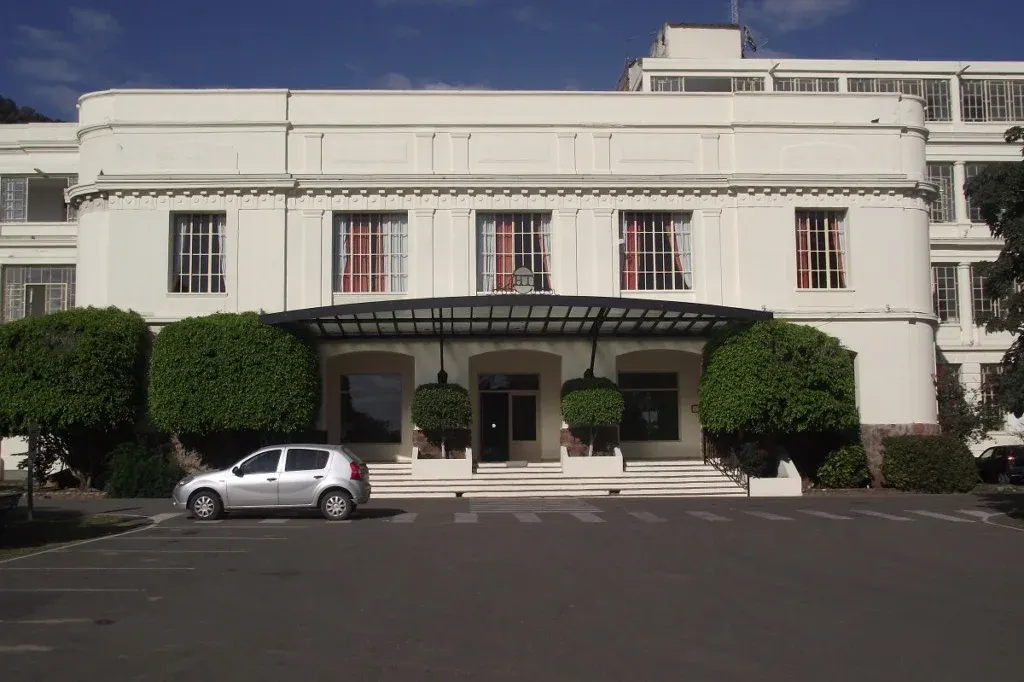
Photo by César Patrocelli, via Wikimedia Commons (CC BY 2.0)
🇦🇷 Argentina · Salta Province
Photo by César Patrocelli, via Wikimedia Commons (CC BY 2.0)
🇦🇷 Argentina · Salta Province
♨ Temperature
48°C
⛰ Altitude
800 m
⚗ pH
7.8
💧 TDS
1480 mg/L
🌊 Flow rate
—
📅 Established
Resort opened 1882
✓ Verified on 2026-07-22
Termas de Rosario de la Frontera is one of Argentina's oldest continuously operating thermal resorts, in Salta Province at the transition between the Andean foothills and the Gran Chaco lowlands. The springs emerge at approximately 48–60°C — cooled for bathing to around 38–42°C — rich in sodium bicarbonate. The Belle Époque Hotel Termas, originally opened in 1882 during Argentina's railway expansion, anchored a resort that served Argentine society and international visitors for over a century. The subtropical setting — warm, green, between the arid Chaco and the cool Andean valleys — creates a microclimate of its own. The thermal waters have historically attracted visitors who combine the waters with visits to the colonial city of Salta and the Quebrada de Humahuaca canyon to the north. The resort continues to attract visitors who value historical atmosphere alongside the thermal springs.
| Sodium Bicarbonate | 680 mg/L |
| Sodium Chloride | 185 mg/L |
| Calcium | 42 mg/L |
| Magnesium | 28 mg/L |
| Sulphate | 95 mg/L |
The town of Rosario de la Frontera takes its name from its historical position as the frontier between the settled interior and the Gran Chaco, dominated by the Toba (Qom) and Wichí peoples. The 1882 thermal hotel was built during Argentine state consolidation and European immigration — partly as a demonstration of civilised amenity at the frontier. It is one of Argentina's oldest surviving thermal resort buildings and represents a specific 19th-century vision of thermal wellness as a socially organised practice.
Rosario de la Frontera's resort represents the 19th-century European cure thermale tradition transplanted to the Argentine interior: a belief that prolonged bathing in specific mineralised waters, combined with rest and regulated diet, could address chronic conditions. This tradition — medically serious, historically exclusive — contrasts with the recreational thermal park culture of other Argentine resorts and continues to attract visitors who value historical character alongside the waters.
The springs emerge from a deep sedimentary aquifer in the sub-Andean fold zone under natural artesian pressure. The historic hotel infrastructure is maintained using locally sourced materials, and the resort's relatively small scale limits its environmental footprint compared to large-scale thermal resort complexes elsewhere in Argentina.
Websitewww.salta.gob.ar
AddressRosario de la Frontera, Salta, Argentina