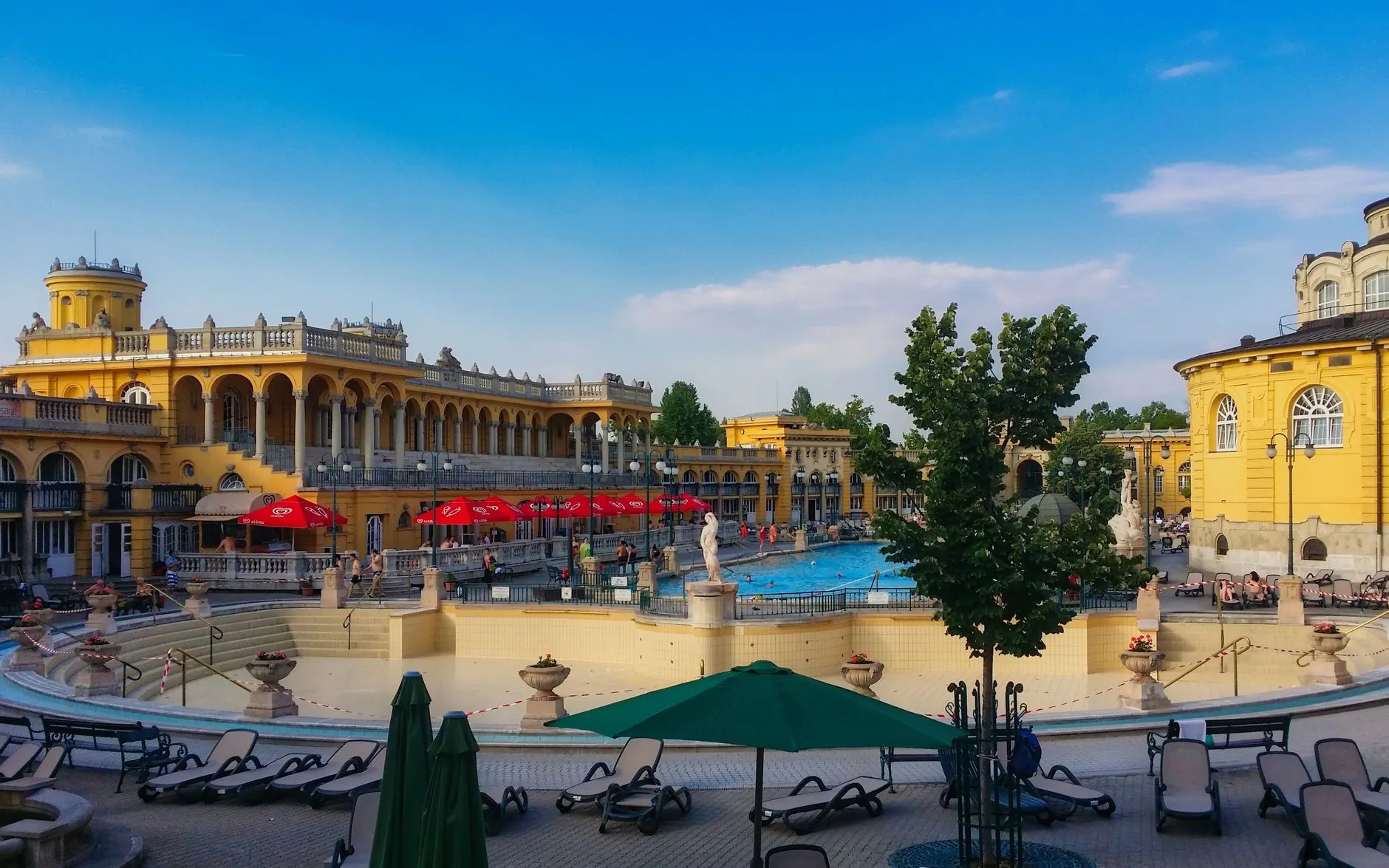
Photo by Loïc LLH, via Wikimedia Commons (CC BY-SA 3.0)
🇫🇷 France · Auvergne, Allier
Photo by Loïc LLH, via Wikimedia Commons (CC BY-SA 3.0)
🇫🇷 France · Auvergne, Allier
♨ Temperature
43°C
⛰ Altitude
263 m
⚗ pH
6.2
💧 TDS
4800 mg/L
🌊 Flow rate
400 L/s
📅 Established
Roman era
✓ Verified on 2026-07-22
Vichy rose to fame as the preferred spa of Napoleon III, who spent three summers here and modernised the town into one of Europe's grandest thermal resorts. Its fifteen springs all rise from the same deep aquifer in the volcanic Auvergne, carrying a high concentration of sodium bicarbonate and natural carbonation. The waters are internationally renowned for treating liver, digestive, and metabolic disorders. Part of the Great Spas of Europe UNESCO inscription.
| Sodium Bicarbonate | 3200 mg/L |
| Carbon Dioxide | 1400 mg/L |
| Chloride | 250 mg/L |
| Sulphate | 180 mg/L |
| Potassium | 95 mg/L |
Part of the Great Spas of Europe UNESCO World Heritage Site (2021), Vichy represents the pinnacle of French 19th-century thermal urbanism. Napoleon III's decision to make Vichy his summer court in the 1860s transformed it into one of Europe's grandest spa cities, with grand palaces, parks, and a spectacular thermal establishment.
The French cure thermale tradition — a medically prescribed three-week thermal cure — gave Vichy a unique status at the intersection of medicine and culture. The Vichy waters inspired France's globally recognised Vichy Célestins mineral water brand, now distributed worldwide. French balneological culture places the spa at the centre of preventive medicine and social ritual.
Vichy's fifteen springs share a single deep volcanic aquifer in the Auvergne, a region with exceptional natural water resource protection legislation. The springs are managed under strict hydrogeological monitoring. The surrounding Auvergne-Rhône-Alpes region contains one of France's highest concentrations of protected natural mineral water sources, with extraction limits enforced to preserve aquifer recharge.